

More than 500 Boston households, including nearly 900 children, could lose federal housing assistance; new requirements set to take effect Dec. 15
Copyright © 2026 Boston Neighborhood News, Inc. This content may not be re-published or re-used without written permission.
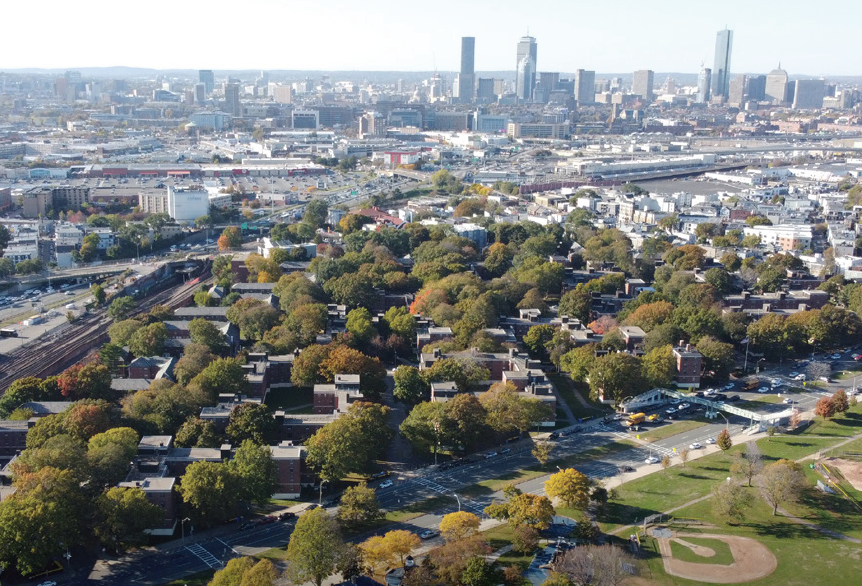
The Mary Ellen McCormack public housing development in South Boston. Boston Planning Dept. image.
The City of Boston and Boston Housing Authority (BHA) have joined a national lawsuit challenging a new Trump administration rule that could strip federal housing assistance from more than 500 Boston families, including nearly 900 children, according to city officials.
The lawsuit, filed Monday in US District Court in Massachusetts, challenges a new Department of Housing and Urban Development (HUD) rule that would largely prohibit families with mixed immigration statuses from receiving federal housing assistance, even when some members of the household are US citizens or otherwise legally eligible for the benefits.
The rule, issued on Nov. 12, is scheduled to take effect Dec. 15, with tenants required to submit proof of citizenship or eligible immigration status by March 14, according to reporting by WBUR.
“Under this cruel and illegal rule, hundreds of children and families in Boston could lose their housing,” Wu said in a statement Monday. “Today, the City and the Boston Housing Authority are joining cities nationwide to halt this unlawful plan and keep families together.”
Nearly 1,000 households across Massachusetts could be affected by the change, according to estimates from the Center on Budget and Policy Priorities, a nonpartisan research organization cited by WBUR. Massachusetts has the fourth-highest number of potentially affected households in the country, behind California, New York, and Texas.
Since 1995, federal housing policy has allowed families with mixed immigration statuses to live together in subsidized housing. Under that arrangement, federal rental assistance is provided only for household members who qualify, while families pay a higher, prorated share of their rent to account for members who are ineligible.
The new HUD regulation would eliminate that longstanding arrangement, potentially forcing families to separate to maintain assistance for eligible members or leave federally subsidized housing altogether.
Kenzie Bok, administrator of the Boston Housing Authority, warned that the policy could reverse years of work to provide stable housing for families that previously experienced homelessness.
“Almost every family we house at the Boston Housing Authority has previously suffered through a period of homelessness,” Bok said. “It is wrong to suddenly change program rules and plunge hundreds of children into that nightmare a second time. These are Boston kids, they are eligible for federal housing in their own right, and they deserve to stay safely in their homes.”
The Trump administration has defended the policy as an effort to ensure that federal housing assistance is reserved for citizens and immigrants who meet eligibility requirements.
HUD Secretary Scott Turner cited lengthy waiting lists for subsidized housing as justification for the new verification requirements. In a statement, Turner argued that the federal government should prioritize eligible applicants, including homeless veterans, seniors, people with disabilities, and victims of domestic violence.
HUD also said an audit conducted with the Department of Homeland Security identified nearly 200,000 tenants nationwide whose eligibility verification was incomplete or unknown.
Housing advocates dispute the administration’s approach, arguing that the existing system already prevents ineligible household members from receiving federal subsidies while allowing families to remain together.
Zafiro Patiño, director of organizing for the Massachusetts Union of Public Housing Tenants, told WBUR that some residents may leave their homes voluntarily rather than submit sensitive immigration information to federal authorities.
“They are going to be separated, or they have to self-evict,” Patiño told WBUR. “That’s what we are hearing mainly — that people are going to be afraid of actually revealing these documents, and they are going to self-evict.”
The regulation could also create significant administrative challenges for housing authorities and tenants. More than 180,000 Massachusetts households receiving federal housing assistance would be subject to the new citizenship or immigration verification requirements, according to WBUR.
The rule would also impose new citizenship verification requirements on residents age 62 and older, potentially creating additional paperwork burdens for thousands of eligible seniors.
The Boston lawsuit is part of a broader legal challenge to the administration’s policy. The city and BHA have joined a coalition that includes New York City, Chicago, Los Angeles, San Francisco, Providence, San Diego, Seattle, and several California housing authorities.
The plaintiffs allege that HUD violated federal law by reversing decades of established housing policy without adequate justification and that the rule conflicts with congressional intent governing federal housing assistance.
Massachusetts has also joined 21 other states and the District of Columbia in a separate legal challenge. Another lawsuit has been filed by a coalition of housing advocacy and tenant organizations, including the Massachusetts Union of Public Housing Tenants, represented by legal organizations including Greater Boston Legal Services and the Massachusetts Law Reform Institute.
Wu urged residents who may be affected to seek guidance from local housing and legal aid organizations while the litigation proceeds. Families concerned about their housing status are encouraged to contact the Massachusetts Union of Public Housing Tenants at 617-825-9750 or Info@massunion.org.
The Boston Housing Authority is expected to provide additional information directly to residents about their due process and appeal rights.
Material from WBUR reporter Rachell Sanchez-Smith’s Nov. 16 report was used in this story. The Reporter and WBUR share content through a media partnership.
Copyright © 2026 Boston Neighborhood News, Inc. This content may not be re-published or re-used without written permission.
