
Black April – a term used by many Vietnamese émigrés to describe the fall of Saigon fifty years ago this week– is a date frozen in time for those who experienced the trauma of war, imprisonment, and displacement from their homeland in Southeast Asia.
For Vietnamese Americans in Dorchester— one of the cultural hubs of the diaspora in the United States— the anniversary also presents an opportunity for healing and reflection across the strong community that has been built here in the last half-century.
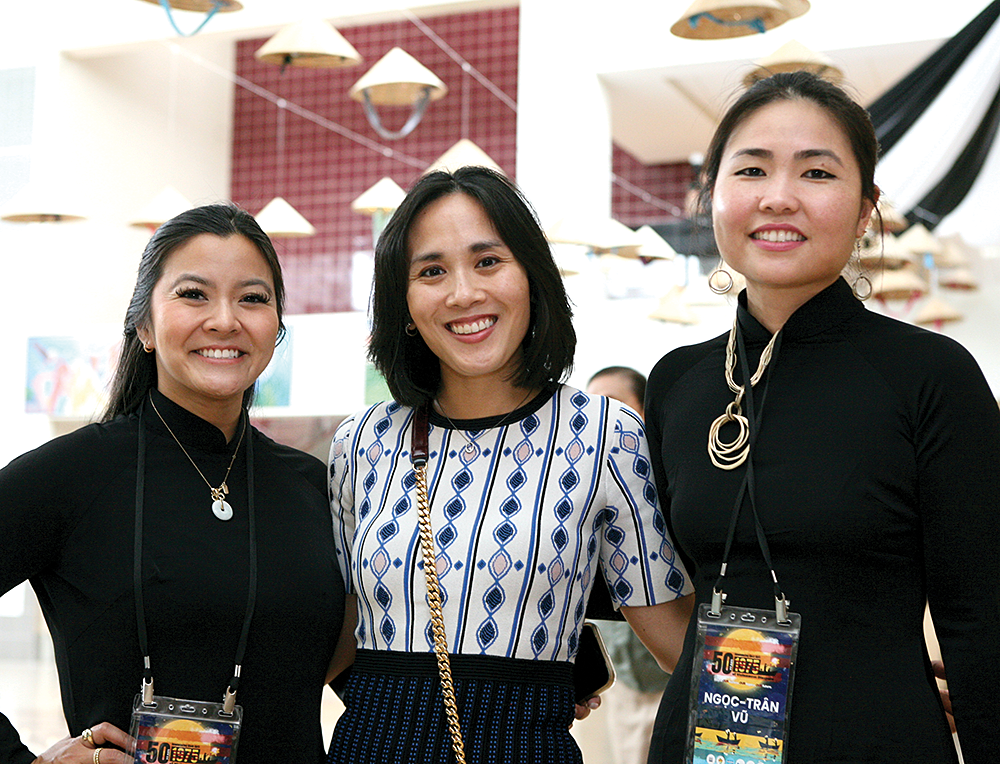
1975 Project Team members Theresa Tran, Debbie Nguyen, and Ngoc-Tran Vu.
That dynamic— largely driven by a generation born here to refugee parents— was on full display at Boston College High School last Saturday as hundreds gathered for a commemorative event that featured speakers, performances, art installations, and food.
Dubbed the “Remembering Black April 50th Anniversary,” the event was organized by Boston Little Saigon, Vietnamese American Community of Massachusetts, 1975: A Vietnamese Diaspora Commemoration Initiative project, VietAID, Cultural Empowerment Organization, and the Massachusetts Vietnamese Scouts Association.
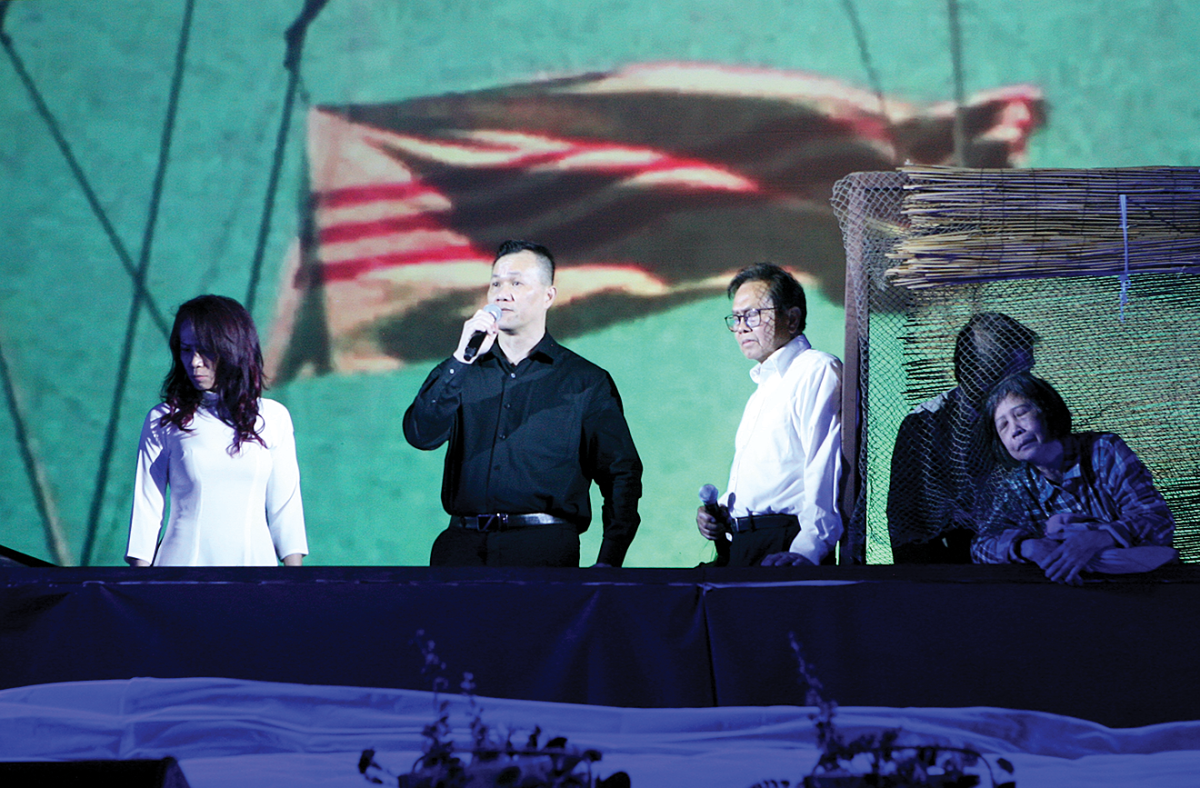
Kim Ngan, Hoang Thong, and Hoang Van sang a medley about the experiences of the ‘boat people’ who made harrowing escapes over the open sea.
“The event went amazingly, and we are very happy to have put together a landmark, multi-media event free and open to the community,” said Ngoc-Tran Vu, lead artist and project director for the 1975 Project.
“The content is hard around the war and coping with that and many older folks here have lived through it…That’s the tragedy of the war and we’re trying to shift the narrative of war to its lasting impacts on families and communities. We often hear about it in a militaristic fashion, but we also want to know what it means to our communities still going through it 50 years later.”
The afternoon saw a cavalcade of entertainment, centered around a type of musical theatre meant to unearth via song, dance, and skit the realities of the oft-told stories of the war itself, of fleeing in its aftermath, and of settling in America. Complicated subjects like the fate of mixed-race Amer-Asian children left behind to deal with a unique set of troubles also found footing during the day. And a museum-quality walk-through exhibition featured detailed, multi-media learning stations.
“The day was carefully curated, right down to the food, which was part of remembering,” Vu noted while explaining that the rice and yucca bowl served was emblematic of what those left behind were forced to eat after the fall.
The memories are still ripe for many of the older people who attended the event. They included former South Vietnamese soldiers and police officers, most of whom had survived “re-education” camps after the American withdrawal, as well as those who arrived as refugees in the early 1980s and those who came in the 1990s.
“Today we remember 50 years of the Vietnamese communist takeover,” said Loc Vu, 75, who was a member of a South Vietnamese Airbourne unit. “It is a very happy day because while we remember all the fighting, we are happy because we have come together, and we can help everybody.”
Dorchester’s Phuc Nguyen, 88, was a university student who joined the Thu Duc Academy in service of the Republic of South Vietnam during the war and served as a public information officer working with the Associated Press and CBS News, among others. But after soldiers from the North captured Saigon, he was sent to a “re-education” camp where he endured what has been described as unspeakable hardships for eight years.
“Luckily, I escaped,” said Nguyen, who fled the camp in 1989 by bus and then via boat to Indonesia, finally arriving in Dorchester in 1995. “I survived the boat in open seas. Luckily, I made it here. I am lucky I survived. My life is a very, very long story.”
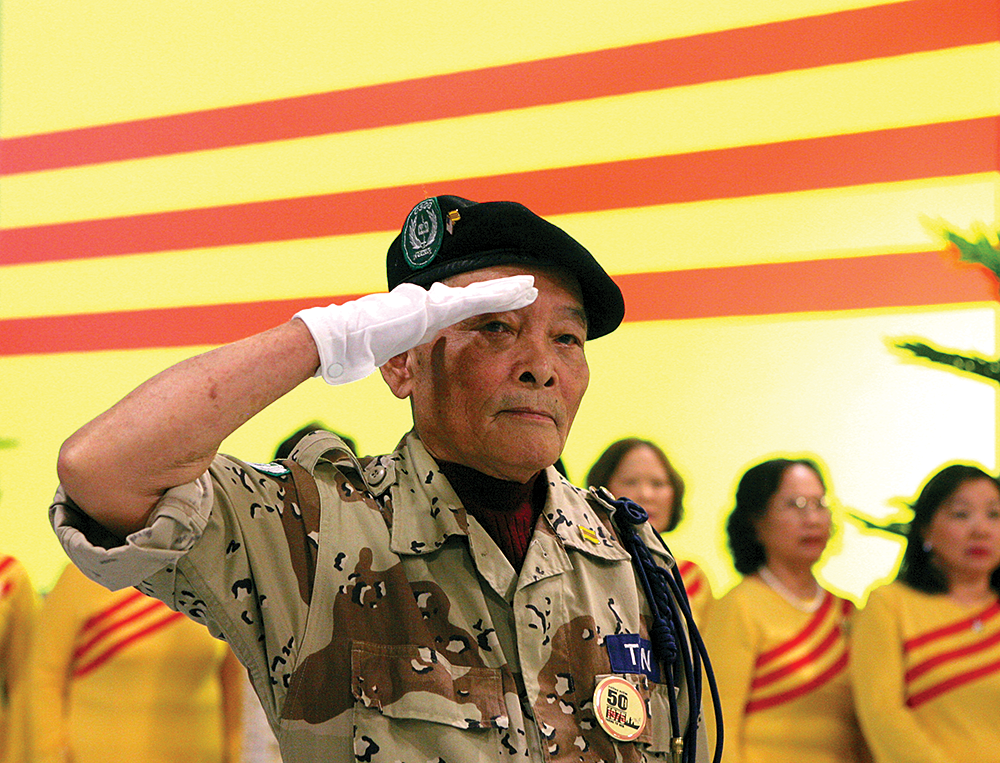
Dorchester’s Pham Nhu Tan led the flag presentation ceremony.
Pham Nhu Tan, a Dorchester resident who was a police officer in South Vietnam and was captured in March 1975, was a guest speaker.
“Sufferings began then and all of us here today are witnesses and victims of the persecutions of communism,” he said.
“Unfortunately, fate had decided this war, and things came to very sad ending,” he added. “To answer all the young generation with questions about the Vietnam war, we’d like to tell you that the Republic of South Vietnam won on all the war fronts, but we have lost the war. Because the nature of the war changed after the 1972 meeting between the US and China.”
Tan said it’s important to remember the sacrifices of the military and of the family members who came here so that today’s ‘generation can be successful in business, politics, science, technology, and culture.”
He noted that this success is part of the “desire to repay our second homeland, America, that has protected us. I would like to thank the US people that with open arms welcomed Vietnamese refugees.”
These remembrances all brought to light the push by the 1975 Project team to create a memorial to the diaspora and the greater community in Dorchester’s Town Field. Team members said that having it sited in the heart of the community will focus attention on the people and community that survived the war and now thrives here.
“For those who fled, survival meant leaving behind everything but memory,” said Linh-Phuong Vu, an outreach specialist and one of the project directors for the 1975 team. “And in the decades since, those memories have flowed quietly but steadily like fireflies in the dark lighting the way for future generations. This is more than a ceremony; it’s a gathering across generations…We come together to not only look back, but also to carry forward the light of those that came before us.
“The next generation carries the firefly’s spark, holding the same stories, the same longings and the same dreams; they are the light-keepers now,” she continued. “This is a legacy moment for those that lived through 1975 and those who inherited its echoes.”
Dignitaries in attendance included Mayor Wu, Council President Ruthzee Louijeune, Councillors Erin Murphy and Ed Flynn, and Andover state Rep. Tram Nguyen.
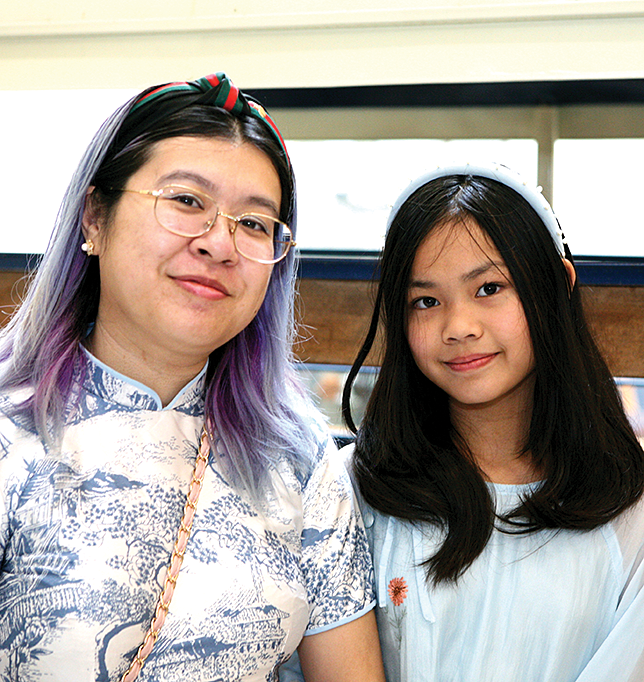
Diana Nguyen and Holly Phan explored the exhibition.
“It was an honor to attend Remembering Black April – 50 Years of the Vietnamese Diaspora,” said Flynn. “We remembered and honored the South Vietnamese military and civilians and US military personnel who fought for freedom, democracy, and human rights. We also celebrated the contributions and sacrifices of the Vietnamese community to our city and nation. Our diversity is our strength.”
